













A Shiny Psychological Battlefield
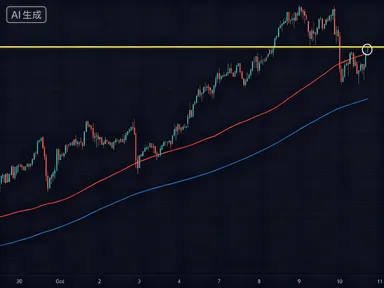
Gold, that eternally glittering obsession of investors and doomsday preppers alike, has once again found itself standing at the psychological battlefield of $4,000 per ounce. The market seems to be suffering from déjà vu — wasn’t it just a few weeks ago when the same number had traders sweating through their tailored suits? Yes, indeed. And now, just as traders were beginning to exhale, the precious metal has decided to test nerves again, hovering near that round and rather terrifying figure.
For most of October, gold has behaved like a caffeinated teenager — soaring above $4,300 one week, collapsing toward $3,900 the next. The recent dip is being framed as a “technical correction,” which is Wall Street’s polite way of saying “panic, but with style.” According to trading platforms, resistance still looms between $4,110 and $4,240, while support sits around $3,975. These numbers, however, seem to mean little to those who’ve already gone grey watching the charts.
What’s behind the mood swings? It’s the same old cocktail of macroeconomic melodrama: the Federal Reserve’s upcoming interest rate decision, global political theater starring Washington and Beijing, and the ever-dramatic whispers of a possible U.S. government shutdown. It’s a financial soap opera — and gold is the dramatic lead that refuses to retire.
Interest Rates, Fear, and the Fed’s Fancy Footwork
At the heart of the current volatility lies the Federal Reserve, that mysterious orchestra conductor of market sentiment. Traders are eagerly betting on a rate cut, clutching at every speech, eyebrow twitch, and PowerPoint slide from Chair Powell as if it were a divine message. A rate cut typically weakens the dollar, which makes gold shine brighter — but only if the markets believe the Fed is serious about staying dovish.
However, it’s not all rainbows and rallies. The lower-than-expected Consumer Price Index (CPI) did bring a sigh of relief, suggesting inflation might finally be tamed. Yet, the reality remains: investors have developed a reflexive dependency on monetary easing. When the Fed hints at tightening, gold tends to sulk; when it talks of cuts, gold throws a glittering party. The problem? No one knows how long the music will last.
The upcoming meeting between President Trump and China’s leadership only adds to the suspense. A trade détente could calm the global markets, potentially diverting funds away from gold. But if talks collapse — and they often do — traders may rush back to their favorite safe haven faster than you can say “inflation hedge.”
To Buy, to Sell, or Just to Breathe?
So, what’s a rational investor supposed to do amid all this glitter-fueled chaos? Most analysts now recommend a cautious stance — or, as one trader joked, “buy the dip, but keep your stop-loss tighter than your budget.” The market’s current sentiment leans mildly bearish in the short term, largely because the recent correction triggered a bout of fear-driven selling. But beneath the surface, long-term investors remain convinced that gold still has a golden future.
The logic is simple: the same forces that propelled gold to record highs remain alive and well. Geopolitical instability? Check. Central bank uncertainty? Double check. A global economy that seems to run on caffeine and denial? Triple check. In this context, every pullback might just be a disguised buying opportunity — provided one has the patience (and the nerves) to handle the rollercoaster ride.
Traders are currently eyeing $3,980 as a potential entry point, aiming for a rebound toward $4,200. The stop-loss suggestion at $3,910 reflects a market that knows its limits but refuses to admit defeat. It’s the financial equivalent of a cautious flirtation — risky, thrilling, and potentially profitable if timed right.
Consolidation: The Calm Before the Next Glitter Storm
Beyond the technical chatter, the gold market appears to be entering what analysts politely call a consolidation phase. Translation: it’s taking a breather before deciding whether to launch another spectacular rally or dive headfirst into despair. Prices may oscillate between $4,000 and $4,300 for a while — a kind of financial limbo where traders oscillate between hope and exhaustion.
Yet, the underlying narrative hasn’t changed. Global uncertainty continues to feed gold’s appeal as a safety blanket. Central banks are still stockpiling it, retail investors are still hoarding it, and the world’s crises — economic, political, and existential — show no sign of slowing down. So while the charts may suggest fatigue, the story of gold is far from over.
For now, the advice remains pragmatic: watch the Fed, track geopolitical headlines, and don’t ignore those suspiciously quiet trading days — they often precede the loudest market moves. Gold, after all, loves drama, and there’s every reason to believe it’s saving some of its best scenes for the weeks ahead.
The Golden Moral
Gold may not always deliver the thrill of a stock rally or the sparkle of a tech IPO, but it remains the market’s eternal heavyweight. Whether it’s fighting the psychological barrier at $4,000 or teasing investors with promises of $4,300, gold continues to prove one truth: it never goes out of style — it merely changes costumes.
So as traders brace for another round of central bank meetings and political theater, the best strategy might just be patience — and perhaps a touch of humor. After all, if history has shown us anything, it’s that gold always finds a way to remind us that glitter, much like greed, is timeless.
Estimated word count: ~1,050