















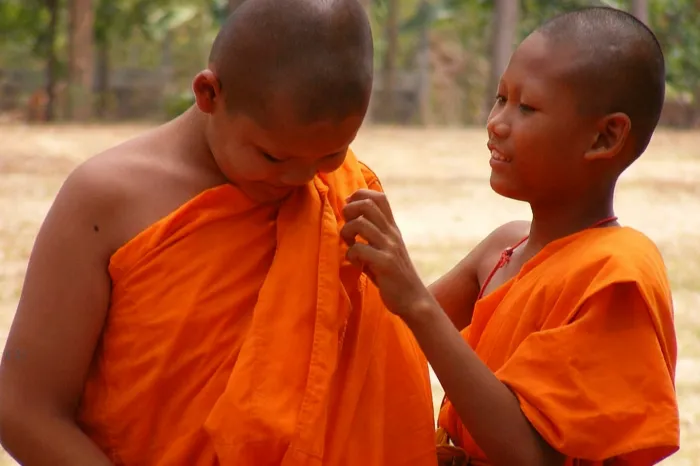
Introduction: The Spectacular Spectacle of Orange
Let’s face it: in case you wander into your nearby temple, turn via the National Geographic channel, or maybe take a walk down a Southeast Asian street, you’re probably to identify some thing that could make a pumpkin proud – companies of Buddhist clergymen draped in diverse sun sunglasses of orange. But why do clergymen put on orange? Is it without a doubt that saffron became the shadeation on cut price whilst the gown keep opened? Is orange the Buddhist model of a superhero cape? Today, we take a adventure into the fabulous, tremendously complex, and—simply so that you know—critically significant global of monastic orange gowns.
Historical Threads: From Rags to Riches (of Meaning)
To hold close the entire glory of monk style, let’s time-tour returned to historic India. Back then, clergymen didn’t have luxurious emblem sponsorships or a tailor named Luigi. Instead, Buddhist kāṣāya gowns have been assembled from discarded or undesirable fabric—assume early recycling, however with greater non secular discipline. These observed fabric have been stitched collectively into 3 essential pieces: the antarvāsa (the internal skirt-like undergarment), the uttarāsaṅga (higher frame gown), and the saṃghāti (outer cloak). While today’s clergymen appearance pristine, their ancestors probably made do with scraps, hand-me-downs, and possibly the extraordinary bedsheet generously donated through the nearby patchwork enthusiast.
And of course, to make the clothing match, they needed to dye them. But here’s in which it receives juicy: in India, the dyes weren’t the popping orange of cutting-edge site visitors cones, however a variety from muddy browns to rusted reds. Saffron—the OG dye of choice—wasn’t a high-style assertion, however a sensible selection stimulated through to be had vegetation and minerals, and, crucially, through the Buddha’s personal sans-fashionista decrees (positive superb shades have been, in fact, forbidden for clergymen—apologies to the ones looking ahead to neon magenta to fashion in Theravada monasteries).
Color Story: Orange, Saffron, and the Family of Tones
Contrary to pop culture, now no longer each monk in each nook of Asia rocks the precise color of tequila sunrise. In Indian Buddhism, gown shades ranged from ochre to deep crimson to even blue and black, relying on one’s sect or the region’s to be had dye vegetation. The orange observed so normally amongst Theravada clergymen, consisting of the ones in Thailand, Sri Lanka, and Myanmar, is usually a glad twist of fate of geography and history.
Why orange, though? Two massive reasons: symbolism and what’s on offer. Orange, derived from herbal plant dyes like turmeric or saffron, is affordable, durable, and, maximum importantly, clean to identify in a crowd (take note, introverts). But on a deeper level, orange and its buddy saffron signify simplicity and letting go. When you spot a monk gliding alongside in a blaze of orange, you’re genuinely witnessing an regular dedication to detachment, humility, and the rejection of luxurious—a style assertion with a mission.
Global Monks: One Religion, Many Wardrobes
Hold on! Just whilst you assume you’ve found out the code, alongside come the rule-breakers. Monks in China? Early on, they cherished red, however grayish-black have become all of the rage throughout the Tang dynasty, possibly as a realistic desire for mixing in whilst sneaking out for nighttime meditations (or perhaps simply due to the fact the laundry turned into easier). Tibetan clergymen? They have a tendency to want deep maroons and reds, growing a form of cosmic shadeation wheel of Buddhist style.
Japan’s Zen masters went patchwork elegant with kesa, square clothes worn elegantly over each shoulders (besides whilst aiming for complete Buddha cosplay, then each are covered). Each country, sect, or even unique temple frequently adopts its personal hue, dictated through tradition, ordination lineage, and the closest to be had plant that dyes matters orange-ish. It’s much less uniform uniformity, extra a colourful, worldwide tapestry of interpretation and neighborhood flair.
Buddha and the Ban at the Bold: Official Rules of the Robe
Now, as a whole lot because it would’ve been unique to look a rainbow-hued brotherhood withinside the monastic line-up, the Buddha banned positive colorings. You won’t see turquoise, gold-lamé, or chartreuse at the authorized list. Why? The identical motive shiny colorings are frequently discouraged in non secular settings: to keep away from attracting undue attention, boasting, or, even worse, beginning a monastic style war. So, orange and its earthy cousins were given the Buddha’s blessing due to the fact they had been subdued, humble, and to be had with out emptying the monastery’s piggy bank. Not that clergymen had piggy banks anyway.
Urban Legends and Modern Monastic Chic
In today’s world, orange monk gowns do have their quirks. Urban clergymen in Thailand would possibly game a gown so electric powered it may manual misplaced plane to safety, at the same time as rural wooded area clergymen have a tendency in the direction of subtler, russet sun sunglasses that mix in higher with the foliage (or so we assume—it’d simply be more difficult to easy dust splatters off mild orange). As one astute observer positioned it, gown colorings in present day Buddhism are nearly like crew flags: Sri Lankan clergymen in burnt orange, Thais in vibrant saffron, Burmese in muted gold—a touch like worldwide soccer, however with extra meditation).
So, consider it or not, in case you spot a monk in specifically colourful orange, you’re in all likelihood searching at an urbanite. Forest dwellers are, as a minimum statistically, much more likely to are trying to find non secular enlightenment in earthier tones. This isn’t a difficult rule, of course—sometimes, clergymen similar to to combine matters up, and a touch traffic-cone orange by no means harm anybody’s karmic stability sheet.
The Symbolism: More Than Just Dye and Fabric
Orange gowns aren’t simply the final results of historical-dye-lot roulette. The importance at the back of the shadeation speaks to the center beliefs of monastic lifestyles: simplicity, non-attachment, and the renunciation of fabric excess. Donning orange isn’t an invite to face out for private glory. Instead, it’s a public signal that the wearer has left at the back of everyday societal goals (profession promotions, loan payments, the quest for the precise selfie angle) in want of religious pursuit.
Plus, using discarded cloth to make the gowns—at the start regularly rags from funeral shrouds or material left to rot—become a bodily act of humility. It become a dedication to locating splendor and really well worth in what society regularly throws away and to residing a lifestyles deliberately reduce from a unique material.
Orange: The Takeaway (and No, Not the Fruit)
Why do clergymen put on orange? Like many non secular questions, the solution is layered: a mix of practicality, geography, rules, rebellion, and a sprint of symbolism that could make even the maximum jaded logician crack a smile. It’s a lifestyle solid withinside the fires of necessity, resourcefulness, and an unwavering dedication to a life-style that—pretty literally—refuses to mixture in with the world’s ordinary dramas.
Next time you byskip with the aid of using a Buddhist monk wrapped in rays of orange, keep in mind you’re witnessing now no longer only a centuries-antique custom, however the residing embodiment of values like humility, mindfulness, and internal freedom. And in case you ever sense the urge to release your personal relatively religious style line, simply know: the Buddha had opinions, the dyes have history, and orange will continually be the brand new black (at the least in the monastery walls).
Conclusion: The Spirit Wears Orange
In the end, the ones colourful gowns are a happy reminder that history, symbolism, and a hint of nearby creativity can mixture (or conflict luminously) to create a lifestyle that’s each undying and completely unmistakable. Orange isn’t always only a shadeation—it is a legacy, a lesson, and possibly the world’s maximum conscious style statement.