





















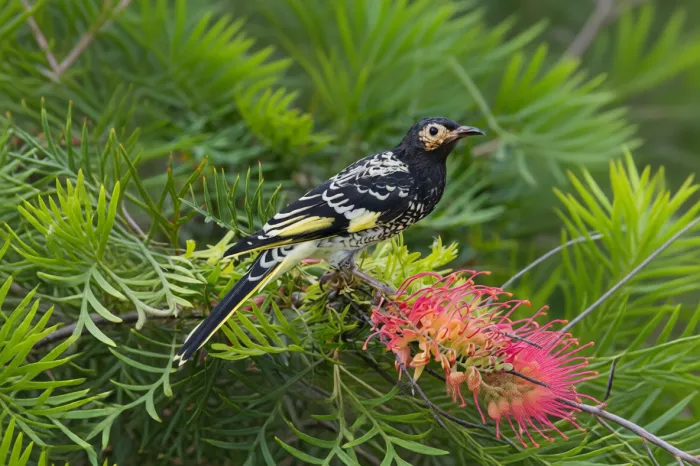
Scientists in Australia have brought new hope for the endangered regent honeyeater by successfully reviving its lost traditional song. The regent honeyeater, a rare bird with fewer than 250 individuals left in the wild, has been at risk of losing not only its population but also its unique social traditions linked to its songs.
The research team from the Australian National University and the Taronga Conservation Society Australia carried out the work at Taronga Zoo in Sydney and Taronga Western Plains Zoo in Dubbo, New South Wales. They used a technique called “song tutoring,” in which young, zoo-bred male honeyeaters were exposed to recordings and live singing lessons from two wild-born male tutors. This helped restore the traditional song, which had almost disappeared due to the shrinking population.
Birdsong is very important for many birds like the regent honeyeater. It helps them find partners, defend their homes, and communicate with other birds. When young birds do not learn the correct song, it can lower their chances of breeding successfully. The study highlighted that if the song traditions are lost, it becomes even harder to save the species.
According to Daniel Appleby, lead researcher from the Australian National University, keeping a shared song or “dialect” is crucial for the reintroduction programs and the bird’s overall survival. Thanks to the efforts, more than half of the zoo’s regent honeyeater population now sings the restored, traditional song.
The scientists hope that this approach will help wild populations keep or regain their song culture, which might improve their breeding success in the future. The method could also be useful for helping other endangered species that might lose important behaviors or social skills. This case shows that protecting animals is not just about their genes, but also about keeping their learned traditions alive.