




















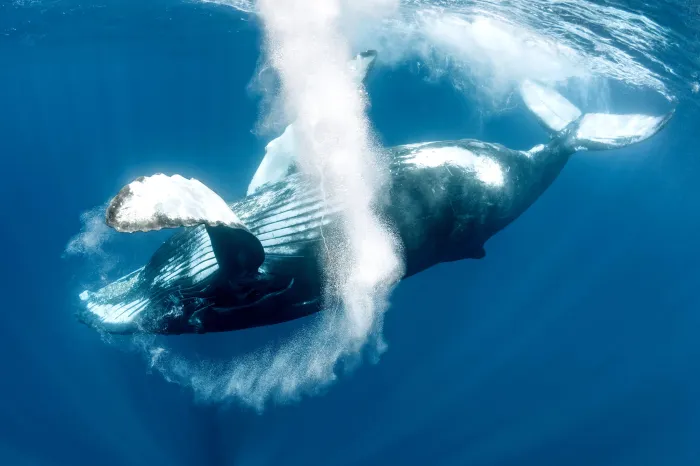
Humpback whales are demonstrating a remarkable ability to share and learn complex songs across vast ocean regions, highlighting a rare example of cultural transmission in non-human species. Recent research led by the University of Queensland has shown that male humpback whales from New Caledonia can learn entire songs from Australian east coast populations with impressive precision. This discovery sheds new light on how whale populations communicate and evolve culturally over time.
The study examined song patterns recorded between 2009 and 2015, analyzing both the number of distinct sounds and the length of song sequences. Researchers found that New Caledonian whales did not simplify or omit any parts of the songs learned from their Australian counterparts, indicating a high fidelity in song transmission. Each year, these whales adopted a different song, demonstrating their capacity to quickly master complex vocal patterns.
This cultural exchange likely occurs along shared migration routes, such as around New Zealand, or common feeding grounds like Antarctica. The findings suggest that whale songs are not static but spread, mutate, and sometimes fall out of fashion much like human pop music. Scientists like Ellen Garland from the University of St Andrews have compared this phenomenon to how popular music travels across cultures, noting that whale songs have been tracked moving halfway across the Pacific Ocean.
Understanding this unique cultural behavior is crucial for conservation efforts. Although humpback whales have recently been removed from the endangered species list, their populations still face threats from environmental changes and human activities. Insights into their communication and social interactions provide valuable information for managing and protecting these marine mammals more effectively.
This research represents a significant step forward in studying animal culture and communication. It offers a new perspective on how non-human species can transmit complex information socially, which may also help scientists understand the evolution of communication in humans. Collaborations between institutions like the University of Queensland and Opération Cétacés in New Caledonia continue to deepen our knowledge of these majestic creatures and their cultural lives.
As climate change and other global challenges impact ocean ecosystems, recognizing the intricate behaviors of humpback whales becomes even more important. These findings encourage further studies into how cultural traits develop and spread among animals, emphasizing that whale songs are not just beautiful sounds but vital elements of their social fabric.