




















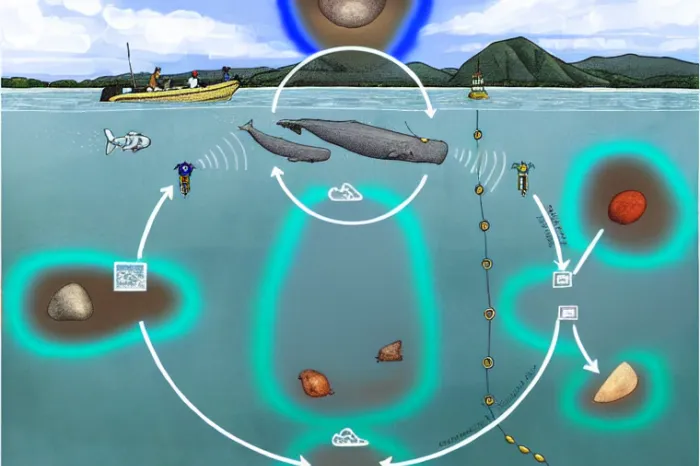
A recent study has unveiled that the clicking sounds sperm whales produce share remarkable similarities with human language patterns. Researchers from Project Ceti have found that these clicks, called codas, follow complex structures that resemble the phonological features of human speech more closely than any other known animal communication system.
Unlike the melodic songs of humpback whales, sperm whales rely on rhythmic clicks for communication. This new research demonstrates that these sounds are not random but instead follow specific, rule-based sequences. The team identified two distinct vowel-like sounds within the clicks—termed a-vowels and i-vowels—that vary in pitch and combine to create intricate sounds akin to diphthongs in human languages.
These vocal patterns show striking parallels to tonal qualities found in languages such as Mandarin and Slovenian. Professor Gašper Beguš from the University of California, Berkeley, who led the Project Ceti study, explained that sperm whales generate these vowel-like sounds through their nasal passages in a manner comparable to how humans produce speech. What was once thought to be simple Morse code-like clicking is now recognized as sophisticated vocalizations with a structure closely mirroring human vowels.
The research also revealed that these complex clicking sequences occur during various social activities among sperm whales—including births, before hunting, and throughout social interactions. This suggests their communication conveys meaningful content, potentially describing detailed concepts or events. Professor Beguš emphasized that the complexity observed in sperm whale communication hints at their ability to discuss nuanced subjects.
Project Ceti’s findings mark a significant advancement in understanding whale communication and its connection to human language. These discoveries open new paths for interpreting cetacean vocalizations and highlight how much remains unknown about animal communication systems. This breakthrough not only sheds light on how whales interact but also narrows the divide between human language and animal vocal expressions.
By challenging longstanding beliefs that animal sounds are simple or instinctual, this study reveals an intricate system likely rich in social meaning. Scientists hope ongoing research will continue decoding these patterns, deepening our knowledge of both sperm whales and the evolutionary roots of language itself.