




















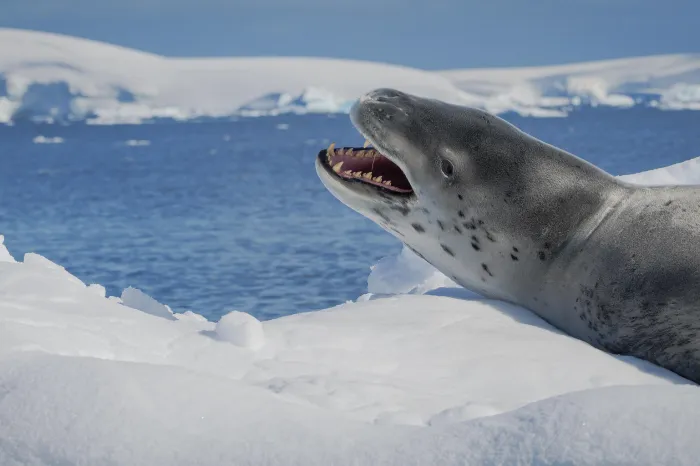
Male leopard seals in Antarctica produce unique songs during the breeding season that share surprising similarities with human nursery rhymes. Researchers studying these vocalizations found that the structure and predictability of the seals’ calls closely resemble the patterns found in simple children’s songs. This discovery sheds new light on the complexity of animal communication, especially among marine mammals.
The study focused on recordings of male leopard seals (Hydrurga leptonyx) in the Davis Sea near Eastern Antarctica. These large predators, which can grow up to 11 feet long and weigh as much as 1,300 pounds, sing underwater for hours at a time during mating season. Their calls consist of five distinct sounds that they arrange into long sequences or “songs,” which can last for up to 13 hours continuously.
Scientists used a mathematical tool called information entropy to measure how predictable or random these vocal sequences are. Remarkably, the seals’ songs showed levels of predictability similar to nursery rhymes such as “Twinkle, Twinkle, Little Star.” Unlike complex music by artists like the Beatles or classical composers such as Mozart, leopard seal songs are more structured and less random, but still allow some variation. This balance likely helps their calls carry clearly over vast distances beneath the Antarctic ice.
Each male seal creates its own signature song by changing the order of the five call types, which include various trills and hoots. The loudness of these calls can reach up to 177 decibels, comparable to a jet engine at takeoff. These vocal performances serve multiple purposes: attracting females for mating and warning other males to stay away from their territory. Researchers describe the seals as “the songbirds of the Southern Ocean” because of their persistent and highly organized singing behavior.
Leopard seals join a rare group of mammals known for producing complex songs, including humpback whales, sperm whales, gibbons, and even some rodents. The study’s findings highlight the advanced nature of their communication system and raise questions about how these song patterns might evolve over time. Scientists are eager to learn whether new call types develop across generations and how this vocal ‘alphabet’ might change.
This research not only expands our understanding of animal vocalizations but also underscores the challenges in decoding the meaning behind these intricate sound sequences. As one researcher noted, it seems the leopard seals are essentially saying, “I’m strong and healthy; listen to my powerful song.” These insights contribute valuable knowledge about how animals use sound to communicate complex messages in harsh environments like Antarctica.