




















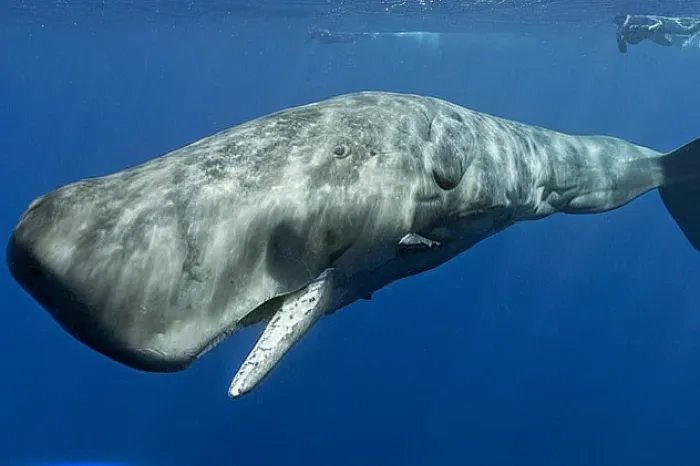
Scientists have uncovered groundbreaking evidence that sperm whale communication closely resembles human speech, offering new insights into the complexity of whale songs and their social interactions. Unlike the well-known songs of humpback whales, sperm whales use rhythmic clicks called codas to communicate. A recent study conducted by researchers at the University of California has shown that these clicks vary not only in timing but also in frequency, much like vowel sounds in human languages.
Over four years, scientists attached underwater microphones to 15 sperm whales to record their vocalizations. Their analysis revealed that sperm whale codas contain two distinct types of clicks, comparable to the vowel sounds ‘a’ and ‘i’ in human speech. These clicks can be combined at different pitches and even produce diphthongs—complex sounds formed by blending two adjacent vowels—similar to languages such as Mandarin Chinese. This discovery suggests that sperm whales may have regional dialects, as different pods use unique click patterns.
The study’s lead author, linguist Gašper Beguš from UC Berkeley, explained that these vocalizations initially seem alien but upon closer examination show remarkable parallels with human language. The research found that the sound waves of the ‘a’ type clicks feature a single peak, while the ‘i’ type have two peaks. Such acoustic features are akin to vowel distinctions found in human languages like Arabic, where vowel length can change word meaning. Similarly, variations in sperm whale clicks appear to alter communication meaning within their groups.
Published in the Proceedings of the Royal Society B, this research highlights the sophisticated nature of sperm whale communication. It suggests that these marine mammals possess one of the most complex linguistic systems observed outside humans. While much about their language remains mysterious, the patterns detected strongly indicate that sperm whales use sound sequences that convey specific information, resembling phonetic and phonological structures seen in human speech.
Sperm whales are known for having the largest brains among all animals on Earth, weighing approximately 20 pounds. They share a distant evolutionary ancestor with humans from around 90 million years ago, which may explain some similarities in communication complexity. The findings mark a significant step forward in understanding how these ancient creatures interact socially through sound.
This new perspective on whale songs expands our appreciation of marine life intelligence and challenges previous assumptions about animal communication. It also opens doors for further research into how whales use sound to maintain social bonds and navigate their underwater world. As scientists continue decoding these vocal patterns, we may one day fully comprehend the rich language hidden beneath the ocean’s surface.