




















Recent scientific research has shed new light on the vocal behavior of whales, revealing complex interactions in their songs and the impact of changing ocean conditions on their singing patterns. These discoveries are reshaping how scientists understand whale communication and the challenges these marine giants face amid environmental shifts.
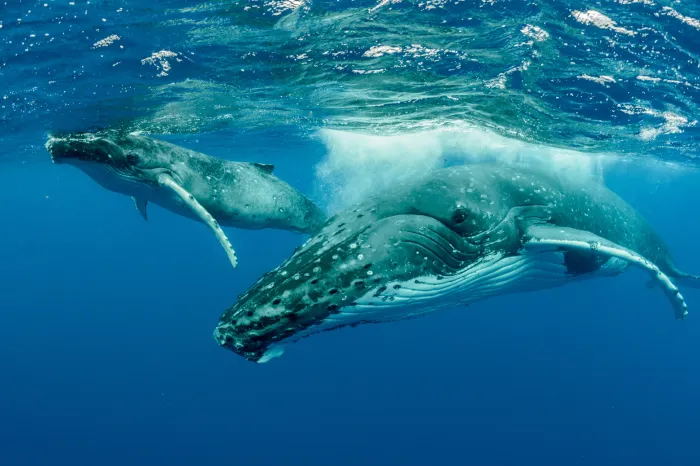
One groundbreaking study focused on humpback whales off the coast of Hawaii, uncovering that these whales adjust the pitch of their songs when another whale begins to sing nearby. This finding highlights a remarkable vocal flexibility previously unrecognized in humpbacks, suggesting their songs are not solo performances but dynamic exchanges. Researchers recorded these interactions using underwater microphones placed on the seafloor, observing how the first singer changed pitch by three to ten hertz when a neighboring whale joined. This behavior indicates real-time listening and response between whales, with some pairs even briefly matching or diverging their pitches in a manner similar to human musicians improvising during a jazz performance.
Unlike earlier beliefs that whales might compete by overlapping identical song themes, this study found that humpbacks tend to avoid overlapping song parts, instead maintaining distinct pitch spaces. This separation likely helps prevent acoustic interference underwater, where sounds can easily blend and become unclear. Such findings emphasize that whale song is a flexible form of communication shaped moment by moment by social context rather than a fixed broadcast.
Meanwhile, another series of studies off California’s coast revealed troubling changes in whale singing behavior linked to environmental stressors. Following a severe marine heatwave in 2015, known as “The Blob,” scientists observed a sharp decline in blue whale songs and those of other species like fin whales. The heatwave disrupted ocean circulation and reduced populations of krill, tiny crustaceans that form the main food source for these large whales. As prey became scarce, blue and fin whales spent more time hunting and less time singing.
Humpback whales showed greater adaptability by shifting their diet from krill to fish such as sardines and anchovies, allowing them to maintain or even increase their singing activity despite the challenging conditions. Researchers used hydrophones combined with machine learning techniques to analyze six years of acoustic data collected from July 2015 through June 2021. They found that while humpbacks gradually increased their song detection rates over this period, blue whale song detections initially rose but then declined after three years as food scarcity persisted.
These findings raise concerns about how increasing ocean temperatures and frequent marine heatwaves might continue to affect whale populations. Blue and fin whales appear more vulnerable due to their specialized diet compared to the more flexible humpbacks. Declines in prey availability not only impact feeding but also disrupt social behaviors such as singing, which is important for mating and communication across long distances.
Scientists emphasize the need for continued monitoring using advanced technologies like multiple hydrophone arrays and animal tagging to better understand how whales interact vocally and respond to environmental changes. Understanding these complex vocal exchanges will help researchers protect these species as they face ongoing threats from climate change and human activity.
Together, these studies reveal that whale songs are far more than simple calls; they are sophisticated social behaviors influenced by both the presence of other singers and the surrounding ecosystem. This evolving knowledge is crucial for conservation efforts aimed at preserving whale populations and the delicate marine habitats they depend on.